A great man is one who collects knowledge the way a bee collects honey and uses it to help people overcome the difficulties they endure - hunger, ignorance and disease!
- Nikola Tesla

Remember, remember always, that all of us, and you and I especially, are descended from immigrants and revolutionists.
- Franklin Roosevelt

While their territory has been devastated and their homes despoiled, the spirit of the Serbian people has not been broken.
- Woodrow Wilson

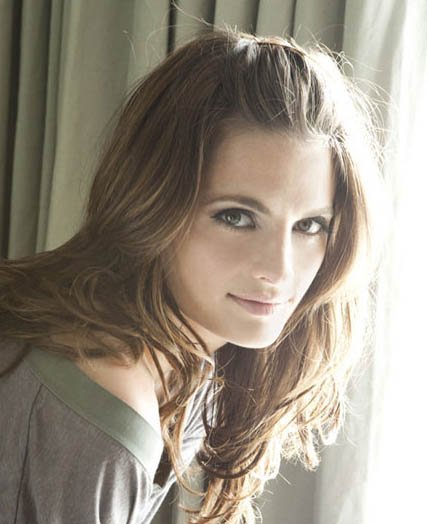
Stana Katic

Stana Katic (born April 26, 1978) is a Canadian film and television actress. She is best known for her portrayal of Detective Kate Beckett on the popular ABC series Castle.

Katic was born in Hamilton, Ontario, Canada, to Serbian parents named Peter and Rada Katić. In describing her ethnicity, she has stated her parents are Serbs. They emigrated from Yugoslavia. Her father is from Vrlika, and her mother is from the surrounding area of Sinj. Katic later moved with her family to Aurora, Illinois. She spent the following years moving back and forth between Canada and the United States.

.

After graduating from West Aurora High School in 1996, she studied acting at Chicago's Goodman School of Drama. She has four brothers and one sister.

 Katic played the character of Hana Gitelman in Heroes, Collette Stenger in 24 's season 5, and Jenny in the film Feast of Love starring Morgan Freeman. She also played Morgenstern in Frank Miller's film The Spirit, Corrine Veneau in the Bond movie Quantum of Solace (though she was originally up for the role of Strawberry Fields in the film), and Simone Renoir in the third installment of The Librarian franchise, The Librarian: Curse of the Judas Chalice.

In August 2008, ABC announced acquisition of the television series Castle, starring Katic as Kate Beckett and Nathan Fillion as Richard Castle.

In 2008, Katic established her own production company, Sine Timore Productions, which is Latin for "without fear."

In the summer of 2010 Katic filmed For Lovers Only with the Polish brothers in France and The Double with Richard Gere.

On January 28, 2012, she was a presenter at the 64th Annual Directors Guild of America Awards ceremony. She was the recipient of the PRISM Award for Performance in a Drama Episode at the 16th Annual PRISM Awards for her portrayal of suffering from Post Traumatic Stress Disorder in the fourth season episode "Killshot" (4x09). Katic was nominated for the 39th People's Choice Awards in the Favorite Dramatic TV Actress category.

From Wikipedia


SA


People Directory

Charles Simic

Charles Simic (born May 9th, 1938) is an American poet. He was born in Belgrade, Yugoslavia (now Republic of Serbia), his childhood was very traumatic, as in the WWII Nazi and Allied bombers ravaged his homeland. Simic emigrated to the USA in 1953 to rejoin his father, who was living in New York City. They moved to Chicago shortly after his arrival. Simic first started to write poetry in high school, when he realized "that one of my friends was attracting the best-looking girls by writing them sappy love poems".

.
Read more ...

Publishing

My Brother's Keeper

by Fr. Radovan Bigovic

Rare are the books of Orthodox Christian authors that deal with the subject of politics in a comprehensive way. It is taken for granted that politics has to do with the secularized (legal) protection of human rights (a reproduction of the philosophy of the Enlightenment), within the political system of so-called "representative democracy", which is limited mostly to social utility or to the conventional rules of human relations. Most Christians look at politics and democracy as unrelated with their experience of the Church herself, which abides both in history and in the Kingdom, the eschaton. Today, the commercialization of politics—its submission to the laws of publicity and the brainwashing of the masses—has literally abolished the "representative" parliamentary system. So, why bother with politics when every citizen of so-called developed societies has a direct everyday experience of the rapid decline and alienation of the fundamental aspects of modernity?

In the Orthodox milieu, Christos Yannaras has highlighted the conception of the social and political event that is borne by the Orthodox ecclesiastical tradition, which entails a personalistic (assumes an infinite value of the human person as opposed to Western utilitarian individualism) and relational approach. Fr Radovan Bigovic follows this approach. In this book, the reader will find a faithful engagement with the liturgical and patristic traditions, with contemporary thinkers, Orthodox and non-Orthodox, all in conversation with political science and philosophy. As an excellent Orthodox theologian and a proponent of dialogue, rooted in the catholic (holistic) being of the Orthodox Church and of his Serbian people, Fr Radovan offers a methodology that encompasses the above-mentioned concerns and quests.