A great man is one who collects knowledge the way a bee collects honey and uses it to help people overcome the difficulties they endure - hunger, ignorance and disease!
- Nikola Tesla

Remember, remember always, that all of us, and you and I especially, are descended from immigrants and revolutionists.
- Franklin Roosevelt

While their territory has been devastated and their homes despoiled, the spirit of the Serbian people has not been broken.
- Woodrow Wilson

Nova saznanja o Nikoli Tesli predstavljena na Harvardu

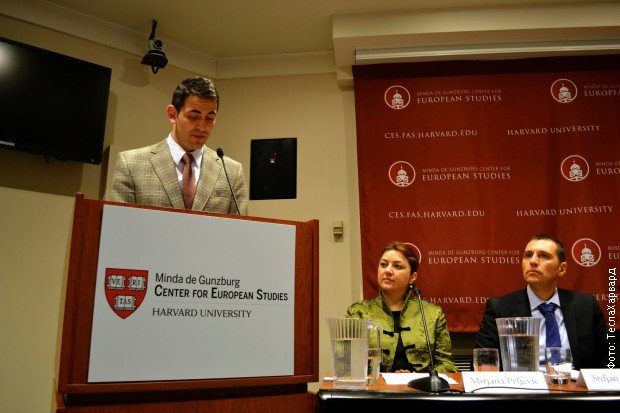
Centar ze evropske studije Univerziteta Harvard i Harvardovo Južnoslovensko društvo organizovali su 11. februara panel koji je predstavio novo lice Nikole Tesle.

Događaj je započeo predavanjem Aleksandra Protića, direktora Tesla memorijalnog projekta i Federalnog savetnika Francuske Federacije za UNESKO o doprinosu svetskom miru Nikole Tesle, kao i o njegovom mestu u međunarodnoj baštini.

U nastavku je održana panel diskusija na kojoj je predstavljena knjiga "Put mira Nikole Tesle" u izdanju UNESKO Centra za mir, "Teslianum" energetskog inovacionog centra i Tesla memorijalnog projekta. Zbornik članaka osvetljava Teslin doprinos svetskom miru, strategijama, filantropiji, održivom razvoju, etičkom preduzetništvu, teme koje su gotovo nimalo poznate u vezi Tesle.

Štampano izdanje knjige se ne prodaje, već poklanja izuzetnim pojedincima koji su se posvetili Tesli.

Digitalna verzija knjige biće svima besplatno dostupna putem interneta. U knjizi, o Tesli pišu nobelovci, akademici, eksperti MENSA-e, UNESKO-a, UNICEF-a, čuveni pisci, profesori i studenti iz različitih zemalja.

.

Gordana Vunjak-Novaković, profesor biomedicine na čuvenom Univerzitetu Kolumbija u Njujorku i dvostruki američki akademik, otvorila je panel govoreći o Teslinoj etici u životu i radu, kao i o poukama koje nam je ostavio. Gi Đoken, direktor UNESKO centra za mir, govorio je o tome šta lideri mogu da nauče od Tesle.

Mirjana Prljević, međunarodni ekspert za strateško pozicioniranje, predsednik Energetskog inovacionog centra "Teslianum" i izvršni direktor Fondacije za mir i rešavanje kriza, analizirala je premijerno Teslu kao primer sjajnog stratega i naglasila da su izuzetni ljudi ključ dobrih strategija.

Srđan Pavlović, predsednik frankfurtske interkulturne mreže Nikola Tesla posvetio se Teslinoj kreativnosti. Zorica Civrić, viši kustos Muzeja nauke i tehnike u Beogradu, predstavila je komparativnu analizu Tesle i Šekspira kao analogiju dva genija. Rave Mehta, pisac bestseler stripa o Nikoli Tesli razmatrao je savremeni pristup istoriji nauke i način na koji Tesla može da inspiriše mlađe generacije.

Pored profesora i studenata univerziteta Harvard, događaju u Harvardovom Centru za Evropske studije prisustvovao je i diplomatski kor, naučnici, preduzetnici i umetnici.

Izvor: RTS


SA


People Directory

Steve Tesich

Steve Tesich was an American Oscar-winning (1980) screenwriter, playwright and novelist.

Tesich was born on September 29th, 1942 as Stojan Tešić in Uzice, Yugoslavia (now Republic of Serbia) and emigrated to the USA with his family when he was 14 years old. They settled in East Chicago, Indiana, and Tesich later graduated from Indiana University in 1965, where he was a member of Phi Kappa Psi Fraternity..

Read more ...

Publishing

Sailors of the Sky

A conversation with Fr. Stamatis Skliris and Fr. Marko Rupnik on contemporary Christian art

In these timely conversations led by Fr. Radovan Bigovic, many issues are introduced that enable the contemporary reader to deepen and expand his or her understanding of the role of art in the life of the Church. Here we find answers to questions on the crisis of contemporary ecclesiastical art in West and East; the impact of Impressionism, Expressionism, Cubism, Surrealism and Abstract painting on contemporary ecclesiastical painting; and a consideration of the main distrinction between iconography and secular painting. The dialogue, while resolving some doubts about the difference between iconography, religious painting, and painting in general, reconciles the requirement to obey inconographic canons with the freedom essential to artistic creativity, demonstrating that obedience to the canons is not a threat to the vitatlity of iconography. Both artists illumine the role of prayer and ascetisicm in the art of iconography. They also mention curcial differences between iconography in the Orthodox Church and in Roman Catholicism. How important thse distinctions are when exploring the relationship between contemporary theology and art! In a time when postmodern "metaphysics' revitalizes every concept, these masters still believe that, to some extent, Post-Modernism adds to the revitatiztion of Christian art, stimulating questions about "artistic inspiration" and the essential asethetic categories of Christian painting. Their exceptionally wide, yet nonetheless deep, expertise assists their not-so-everday connections between theology, ar, and modern issues concerning society: "society" taken in its broader meaning as "civilization." Finally, the entire artistic project of Stamatis and Rupnik has important ecumenical implications that aswer a genuine longing for unity in the Christian word.

The text of this 94-page soft-bound book has been translated from the Serbian by Ivana Jakovljevic, Fr. Gregory Edwards, and Andrijana Krstic. Published by Sebastian Press, Western American Diocese of the Serbian Orthodox Church, Contemporary Christian Thought Series, number 7, First Edition, ISBN: 978-0-9719505-8-0