A great man is one who collects knowledge the way a bee collects honey and uses it to help people overcome the difficulties they endure - hunger, ignorance and disease!
- Nikola Tesla

Remember, remember always, that all of us, and you and I especially, are descended from immigrants and revolutionists.
- Franklin Roosevelt

While their territory has been devastated and their homes despoiled, the spirit of the Serbian people has not been broken.
- Woodrow Wilson

Nick Vujicic

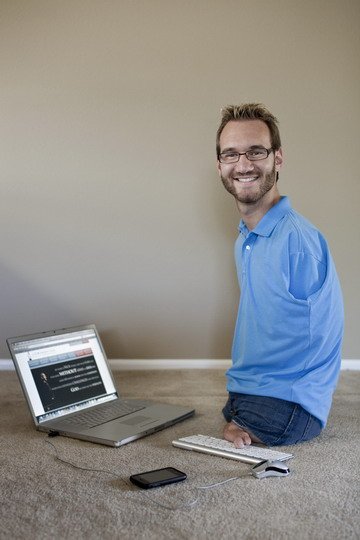
Nicholas James Vujicic (/ˈvɔɪtʃɪtʃ/ voy-chich; Serbian: Николас Џејмс Вујичић, Nikolas Džejms Vujičić; born 4 December 1982) is a Serbian Australian evangelist and motivational speaker born with tetra-amelia syndrome, a rare disorder characterised by the absence of all four limbs. As a child, he struggled mentally and emotionally as well as physically, but eventually came to terms with his disability and, at the age of seventeen, started his own non-profit organisation, Life Without Limbs. Vujicic presents motivational speeches worldwide, on life with a disability, hope and finding meaning in life. He also speaks about his belief that God can use any willing heart to do his work and that God is big enough to overcome any and all disabilities.

.

The eldest child of his family, Vujicic was born in Brisbane, Australia. He was limbless, missing both arms at shoulder level, as well as legs. Where human legs are located, he has a small foot with two toes. Initially, his parents were devastated, though Vujicic was otherwise healthy.

Originally prohibited by Victoria state law from attending a mainstream school because of his physical disability, even though he was not mentally impaired, Vujicic became one of the first disabled students integrated into a mainstream school once the laws changed.

Being bullied at school for his limbless disability, Vujicic grew depressed and by the age of eight, contemplated suicide. At age ten he tried to drown himself, but did not go through with it out of love for his parents. After praying to grow arms and legs, Vujicic eventually realised that his accomplishments could inspire others – and became grateful for his life. A key turning point came when his mother showed him a newspaper article about a man dealing with a severe disability. Vujicic realized he wasn't unique in his struggles and began to embrace his disability.

He began to master the daily tasks of life. He learned to write using the two toes on his left foot with a special grip that slid onto his big toe. He learned to use a computer and type using the "heel and toe" method. He learned to throw tennis balls, play drum pedals, get a glass of water, comb his hair, brush his teeth, answer the phone and shave.

In Year 7 he was elected captain of his school and worked with the student council on fundraising events for local charities and disability campaigns. When he was seventeen, he started to give talks at his prayer group, and eventually started his non-profit organisation, Life Without Limbs.

In 2005 Vujicic was nominated for the Young Australian of the Year Award.

Vujicic currently lives in California. On 12 February 2012, he married his fiancée, Kanae Miyahara.

Vujicic graduated from Griffith University at the age of 21 with a double major in accountancy and financial planning. Subsequently he became a motivational speaker, travelling internationally and focusing on teen issues. Having addressed over three million people in over 24 countries on five continents, he speaks to corporate audiences, congregations and schools.

Vujicic promotes his work through television shows and through his writing. His first book, Life Without Limits: Inspiration for a Ridiculously Good Life (Random House, 2010) was published in 2010. He markets a motivational DVD, Life's Greater Purpose, a short documentary filmed in 2005 highlighting his home life and regular activities. The second part of the DVD was filmed at his local church in Brisbane – one of his first professional motivational speeches. He markets a DVD for young people titled: No Arms, No Legs, No Worries: Youth Version.

In March 2008, he was interviewed by Bob Cummings for 20/20.

He starred in the short film The Butterfly Circus which won the Doorpost Film Project's top prize of 2009, and the Best Short Film award at the Method Fest Film Festival, where Vujicic was also awarded Best Actor in a short film. Butterfly Circus also won the best short film award at The Feel Good Film Festival in Hollywood in 2010.

From Wikipedia


SA


People Directory

Bishop Jovan (Mladenović)

(1994–2002)

The Divine provision brought the spiritual father of the Monastery Studenica, Bishop Jovan, to continue the work left by the equally most esteemed and humblest spiritual father of the Monastery Hilandar, Bishop Chrysostom.

As an accomplished monastic with the spiritual wealth he attained in the Studenica Monastery, he enriched his flock and clergy. Very soon he gained respect and confidence of his clergy and the faithful.

Bishop Jovan was born in 1950 of father Radojko and mother Stana Mladenović in the village of Dobrace, near Arilje, Serbia. He finished elementary school in his village. At the age of twelve, he went to the Klisura Monasteiy where he remained for one year and then went to the Studenica Monastery. He attended the monastic school in the Ostrog Monastery from 1967 until 1969. He was ordained a hierodeacon in the Studenica Monastery on April 25, 1971. He retained his baptized name of Jovan. Rt. Rev. Vasilije, Bishop of Žiča ordained him as hieromonk in 1973. He graduated from St. Sava Seminary in Belgrade in 1974 and from Theologcial College in Belgrade in 1980.

Read more ...

Publishing

Serbian Americans: History—Culture—Press

by Krinka Vidaković-Petrov, translated from Serbian by Milina Jovanović

Learned, lucid, and deeply perceptive, SERBIAN AMERICANS is an immensely rewarding and readable book, which will give historians invaluable new insights, and general readers exciting new ways to approach the history​ of Serbian printed media. Serbian immigration to the U.S. started dates from the first few decades of 19th c. The first papers were published in San Francisco starting in 1893. During the years of the most intense politicization of the Serbian American community, the Serbian printed media developed quickly with a growing number of daily, weekly, monthly and yearly publications. Newspapers were published in Serbian print shops, while the development of printing presses was a precondition for the growth of publishing in general. Among them were various kinds of books: classical Serbian literature, folksong collections, political pamphlets, works of the earliest Serbian American writers in America (poetry, prose and plays), first translations from English to Serbian, books about Serb immigrants, dictionaries, textbooks, primers, etc.

Read more ...