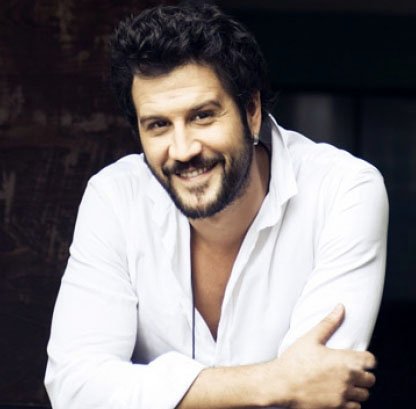
Stefan Kapicic was born in Koln, Germany, where he lived for 3 years while his father played professional Basketball. His family returned to Belgrade, Serbia, where he attended high school and later enrolled in the Academy of Philosophy; studying World Literature for two years. Stefan's mother, Beba Zugic is a well known actress in Serbia and with her influence, he grew up wanting to act.
.During his childhood, he went to every theatre performance that Belgrade had to offer, took extensive acting classes, and later auditioned at the Academy of Dramatic Arts in Belgrade, considered to be one of most respected drama schools in Europe. After he got accepted, Stefan was taught by professor Gordana Maric and legendary professor Minja Dedic.
During his first year in the Academy of Dramatic Arts, Stefan was offered to join the serbian National Theatre, and performed in a play called "HASANAGA'S WIFE", directed by Award Winning director Jagos Markovic. Soon after, his career sky-rocketed, and he performed in about 50 theatre performances such as; "MERCHANT OF VENICE" by W. Shakespeare, " ELECTRA" by Euridipus, "BROTHERS KARAMAZOV" by F.M. Dostojevsky, "DEATH" by Woody Allen, " PROMETHEUS" by Euridipus, " RESSURECTION BLUES" by Arthur Miller, "STREET CAR NAMED DESIRE " by T. Williams, etc.
In 2003, he starred in his first feature film role in "ALMOST TOTALLY ORDINARY STORY" in which he got Awarded as "Best Debutant" at 'Nis Film Festival' 2003. Later on, offers for features just kept coming. Stefan starred in films such as; "THE CORDON" by Goran Markovic, "STREET WALKER" by Kosta Djordjevic, "FREE FALL" by Vladimir Djukelic, "CHARLESTON AND VENDETTA" aka "Tears for Sale" by Uros Stojanovic, produced by Luc Besson, premiered at 2008 'Toronto Film Festival', and "THE BROTHERS BLOOM" directed by Rian Johnson, a feature starring Oscar Winners Adrian Brody, Rachel Weisz and Maximillian Shell.
Stefan has also starred in several TV-sitcoms: "ORDINARY PEOPLE", "I, CHEGUEVARA", " VRATICE SE RODE"; did commercials for Pepsi, Nestle, Snickers, Tommy Hilfiger, Pal Zileri, and voice-overs for "GARFIELD 2", "OPEN SEASON", "POKEMON", "LOONEY TUNES", "ALADDIN", for the European market.
Stefan Kapicic relocated to Hollywood in 2008, where he guest starred in two popular CBS' TV-Shows – 'THE UNIT' and 'NUMB3RS', the 8th and final season of FOX's popular TV-Show '24', and NBC's "THE EVENT". You can currently see Stefan in popular Croatian TV-show "LARA'S CHOICE", and next on the big screen in UNIVERSAL PICTURES' feature "BIG MIRACLE", premiering on February 3rd, 2012.