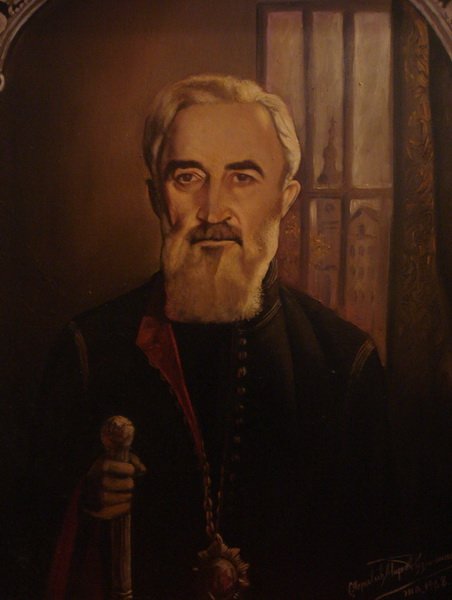
Bishop Damaskin was born in Leskovac in 1892. He graduated from the nine year St. Sava Seminary in Belgrade, while simultaneously attending the Belgrade Music School. After finishing the Seminary, he taught music at the First High School in Kragujevac. Received into the monastic order at Rakovica Monastery by Archimandrite Platon, later martyred as Bishop of Banja Luka, he studied at the St. Petersburg Theological Academy where he received a Master's Degree in Theology in 1917. He then went to Freiburg, Switzerland where he obtained a Ph.D. in Philosophy.
Until his election as Bishop he was Army Chaplain for our Second Volunteer Division in Russia, taught at the St. Sava Seminary in Belgrade, and during the First World War he was in England, then in Belgrade and Sremski Karlovci. From 1922 until 1923 he was First Secretary of the Serbian Patriarchate, and in 1924 became assistant professor at the Faculty of Theology in Belgrade. He occupied this position when he was elected Bishop of Mukachevo and Priashevo in 1931.
Damaskin, the new Bishop of America and Canada, left Belgrade for his new Diocese on September 25, 1938 "with fatherly love and a burning desire to serve and guide her in her spiritual and patriotic aspirations and desires." The furrow that the new Bishop plowed was very deep; new strength and inspiration were felt everywhere in the American-Canadian Diocese. While still en route to St Sava Monastery in Libertyville, before his enthronement, Bishop Damaskin wrote to Rev. Milan Brkic from New York: “Tomorrow I shall have a meeting here with our people from New York about founding a parish.” Immediately after his election Bishop Damaskin asked the Holy Synod to assign him Hieromonk Amvrosije Veselinovic, a professor at the Bitolj Seminary, for he wished "to establish monastic life and uninterrupted worship at the Monastery”. He was sent, however, Hieromonk Grigorije Udicki, also a professor at Bitolj Seminary
Awaiting the Bishop were many diocesan problems that had been piling up over the years and required solution. In particular, he had to resolve the question of religious education, find ways to finance the clergy, locate priests, train chanters for every parish church, establish monastic life at St. Sava Monastery in Libertyville, thereby solving the problem of its support, and also secure the Diocese financially. Almost all these problems were in the domain of the National Church Assembly which, at Bishop Damaskin’s request, would be held that same autumn. Whatever did not depend on the Assembly, or other ecclesiastical bodies, Bishop Damaskin dealt with himself, for example, the matter of financial security for parish priests, not only their monthly salaries but also their Pension Fund.
The Depression had financially weakened our church congregations in the American-Canadian Diocese, and supporting a parish priest had become a great problem. Help was therefore needed from the old country, from both Church and State. The position of our emigrants at the time of Bishop Damaskin’s arrival in America can be seen from a Report from the Honorary Royal Consulate in Pittsburgh
The National Church Assembly of the Serbian Orthodox Diocese of America and Canada was held in Chicago between November 30 and December 2, 1938. Participating in this Assembly, the third, in addition to its chaim1an Bishop Damaskin, were 27 priests (two from California Archimandrite Georgije Kodzic and Archpriest Mirko Vujisic did not attend because of the distance), 52 delegates from church-school congregations and four members of the Diocesan Council. If one bears in mind that some of the delegates also represented other congregations, there were exactly 100 votes at the Assembly.
Having opened the Assembly, 'Bishop Damaskin greeted the participants present and Dr. Petar Cabric, Consul-General of the Kingdom of Yugoslavia, and then explained why he had convened the Assembly.
Bishop Damaskin’s year of fruitful work was suddenly interrupted because at an Extraordinary Meeting of the Holy Assembly of Bishops on December 8, 1939 Bishop Damaskin was elected Bishop of the vacant Diocese of Banat, and Bishop Dionisije (Milivojevic) was elected his successor.