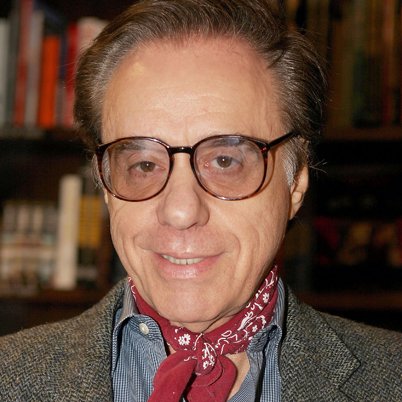
He was influenced by the French critics of the 1950s who wrote for Cahiers du Cinema, especially criticturned-director Francois Truffaut. Before becoming a director himself, he built his reputation as a film writer with articles in Esquire.. In 1968, following the example of Cahiers du Cinema critics Truffaut, Jean-Luc Godard, Claude Chabrol, and Eric Rohmer who had created the Nouvelle Vague ("New Wave") by making their own films, Bogdanovich decided to became a director. He went onto work with Corman on the critically praised Targets and Voyage to the Planet of Prehistoric Women. Bogdanvich later referred to Corman and his company as the best film school he could ever have when he made his first feature film.
Turning back to journalism, Bogdanovich struck up a life-long friendship with the legendary Orson Welles while interviewing him on the set of Mike Nichols's adaptation of Joseph Heller's Catch-22. Subsequently, Bogdanovich has played a major role in elucidating Welles and his career with his writings on the great actordirector, most notably his book This is Orson Welles (1992).
The 32-year old Bogdanovich was hailed by a critics as a Wellesian wunderkind when his most famous film, The Last Picture Show, was released in 1971. The film received eight Academy Award nominations, including Bogdanovich as Best Director, and won two of them, for Cloris Leachman and Ford film veteran Ben Johnson in the supporting acting categories.
Bogdanovich followed up The Last Picture Show with a major hit, What's Up, Doc? (1972), a screw-ball comedy heavily indebted to Hawks' Bringing Up Baby (1937) and His Girl Friday (1941), starring Barbra Streisand and Ryan O'Neal. Despite his reliance on homage to bygone cinema, Bogdanovich had solidified his status as one of a new breed of A-list directors that included Academy Award winners Francis Ford Coppola and William Friedkin, with whom he formed The Directors Company. It was through this entity that Bogdanovich's next big hit, the critically praised Paper Moon (1973), was produced.
Paper Moon, a Depression-era comedy starring Ryan O'Neal that won his 10-yearold daughter Tatum O'Neal an Oscar as Best Supporting Actress, proved to be the highest point of Bogdanovich's career. The Directors Company subsequently produced only two more pictures, Coppola's critically acclaimed The Conversation, which was nominated for an Academy Award for Best Picture of 1974 and garnered Coppola an Oscar nod for Best Director, and Bogdanovich's Daisy Miller, a film that had a quite different critical reception.
In 1998, the National Film Preservation Board of the Library of Congress named The Last Picture Show to the National Film Registry, an honor awarded only to the most culturally significant films.
Filmography:
- Hustle (2004) (made for TV, ESPN)
- The Cat's Meow (2001)
- The Thing Called Love (1993)
- Noises Off (1992)
- Texasville (1990)
- Illegally Yours (1988)
- Mask (1985)
- They All Laughed (1981)
- Saint Jack (\919)
- Nickelodeon (1976)
- At Long Last Love (\915)
- Daisy Miller (1974)
- Paper Moon (1973)
- What's Up, Doc? (1972)
- The Last Picture Show (1971)
- Voyage to the Planet ofPrehistoric Women (a.k.a. The Gill Women of Venus and The Gill Women) (1968)