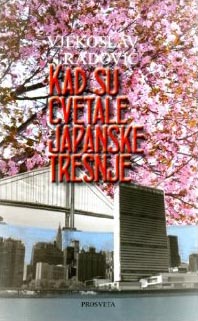
 When it comes to Japanese cherries, they are blossoming for the sake of beauty itself, without producing fruit. Author Vjekoslav Radović masterfully uses this metaphor throughout his remarkable new novel. Radović’s main characters are somewhat nostalgic, but primarily they are realists. Most of them are quite aware that in today’s world “only evil multiplies without any difficulty and beauty is rarely found, sometimes completely infertile.” Like its Serbian title, the novel blossoms early and beyond expectations. It blossoms to paradoxically show its beauty and positive messages, while describing the lives of people who experienced a lot of suffering, loss of a country, and seemingly unsolvable situations in the United States. How can a story about the Serbian suffering, the destiny of Kosovo, typical lives of American immigrants, a lonely Serbian man whose main motivation in life is revenge, the Albanian mafia in the Bronx, and other depressing topics also contain so much positive emotion, including tenderness? For those of us who know Radović this is not surprising, but for many readers this can be a great discovery.
We don’t have to wait for the spring to come and for Japanese cherry blossom festivals to celebrate the bravery and originality of ideas displayed in this novel. We can do that now. I would recommend to all readers to avoid reading plot summaries and let themselves be immersed into the reality of Radović’s characters. No summary does any justice to this complex and imaginative story. I was captivated immediately.
.The first pages of this novel contain a letter written by Veljko--the narrator. Just that letter alone could be published separately and analyzed for its wisdom and wit. Most of the action happens in New York, some in Belgrade, and other parts of the former Yugoslavia. Radović writes about the immigrant life in New York, the United Nations, and the dark corners of the Bronx, vividly and with authority. He himself lived in New York for more than two decades. At the moment only bilingual Yugoslav Americans can enjoy this novel, while the English translation is awaiting publication. I believe that it would be very important for wider circles of American readers to have an opportunity to read this story.
We should give proper credit to Mr. Radović for tackling multiple unpopular and politically incorrect topics. Even though this is a work of fiction, it still takes bravery to write about the destiny of Serbs in Kosovo, terrorism, interests of the global empire, global connections of the Albanian mafia operating in Kosovo and in New York…The main (Serbian) character who grew up in Kosovo is presented as a complex individual, fully human. I believe that American reading audiences would benefit from being exposed to such complexity. This is a much needed effort to bring the humanity back to stigmatized groups, while resisting idealization as the other extreme. Mr. Radović took a risk of being misunderstood from all sides, including Serbian readers. In Serbia, this novel has received a warm welcome from diverse audiences and the prestigious NIN Award nomination.
One idea communicated in this book deserves a very special attention. Radović’s characters tell us that there were invaluable advantages found in the Yugoslav way of life. They also tell us that even Albanians and Serbs could realize one day--especially if they are immigrants fighting for survival in a foreign land--that they have more in common than previously thought. At the beginning stages of immigration, most tend to think that there are many common values that would bring them closer to their host countries and the interests of the global ruling elites. But the more they get disillusioned about their lives in the most powerful countries, the more they think about what really brings people together. In this novel, Zoran and Agim talk about the specific scent of the soil in their homeland; something that goes deeply into people’s subconscious and transfers through DNA. They believe that kind of connection to the land and common experiences of their ancestors bind them together, despite all differences.
All characters in Radović’s novel are very well developed. He deserves a special credit for his female characters. Most male authors are often unable to penetrate into the deepest secrets of the female soul, but Radović masterfully describes their intimate worlds.
One of the chapters that I will remember the most is the one entitled Japanese Cherries. That chapter alone could be turned into an exciting movie with a love story in the center.
As a writer myself, I had to laugh when Veljko warned his friends to behave because they could be described in his novel authentically, and therefore not very proud after its publication. If the written word still has this power, perhaps we should all think about this warning and continuously self-examine. Regardless of how we approach the power of fiction as a genre and the impact of the published word, many would recognize themselves in this story. It is a breath of fresh air and highly recommended.
Milina Jovanovic