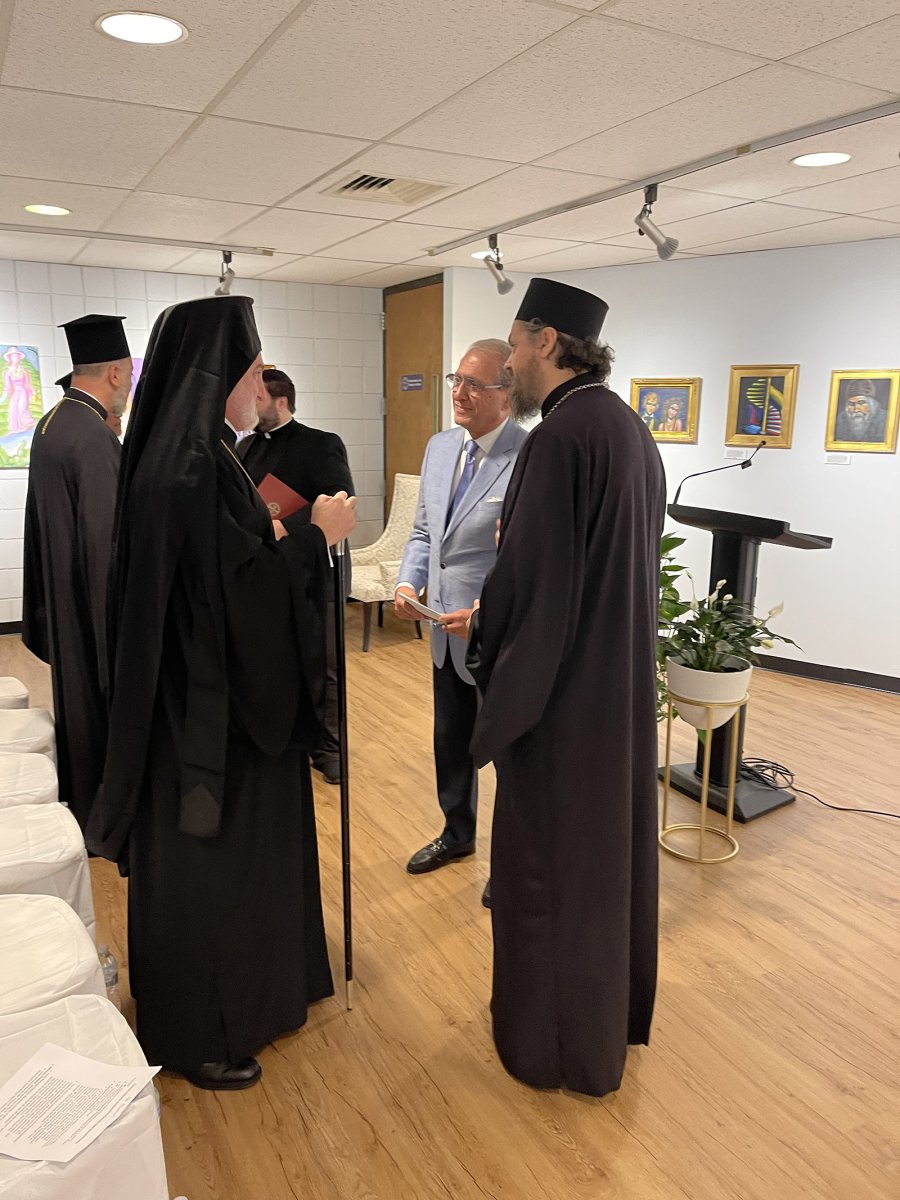
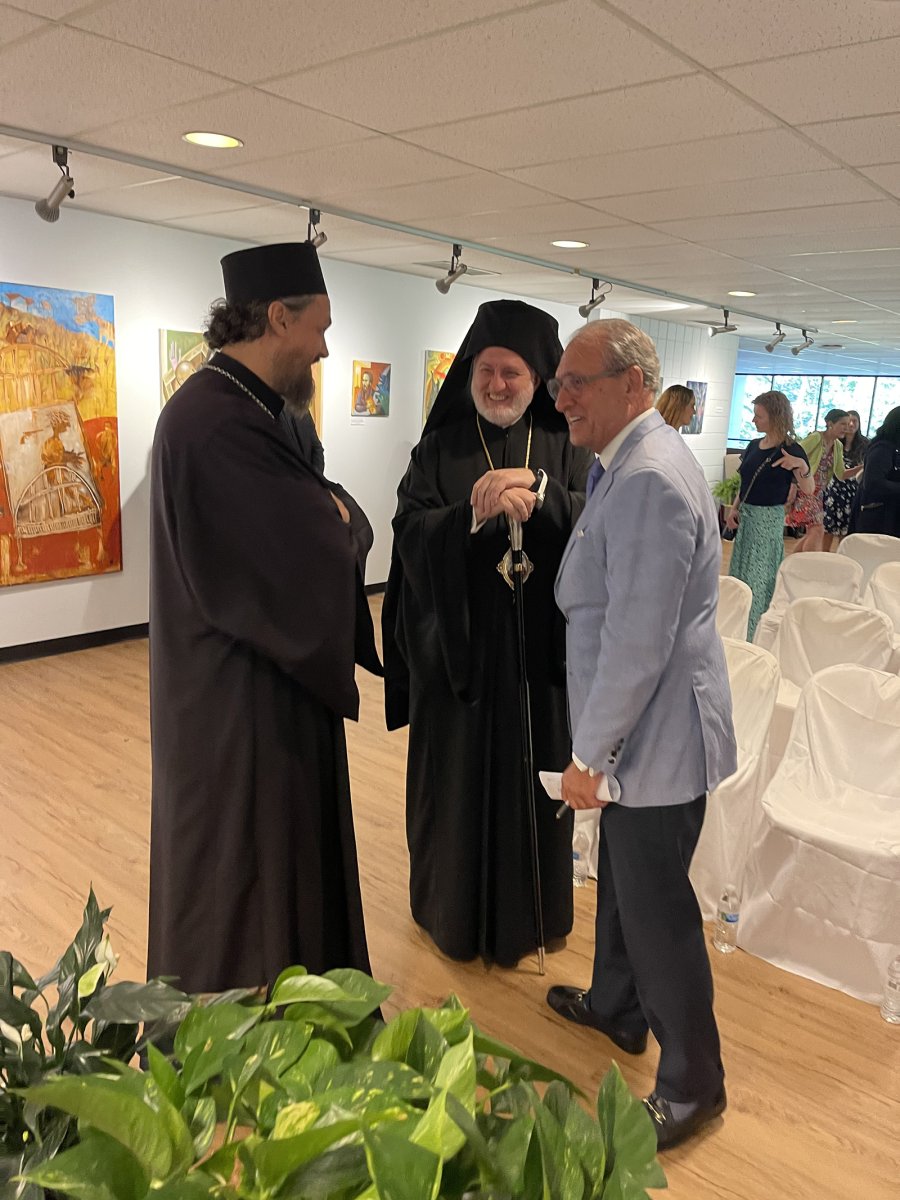
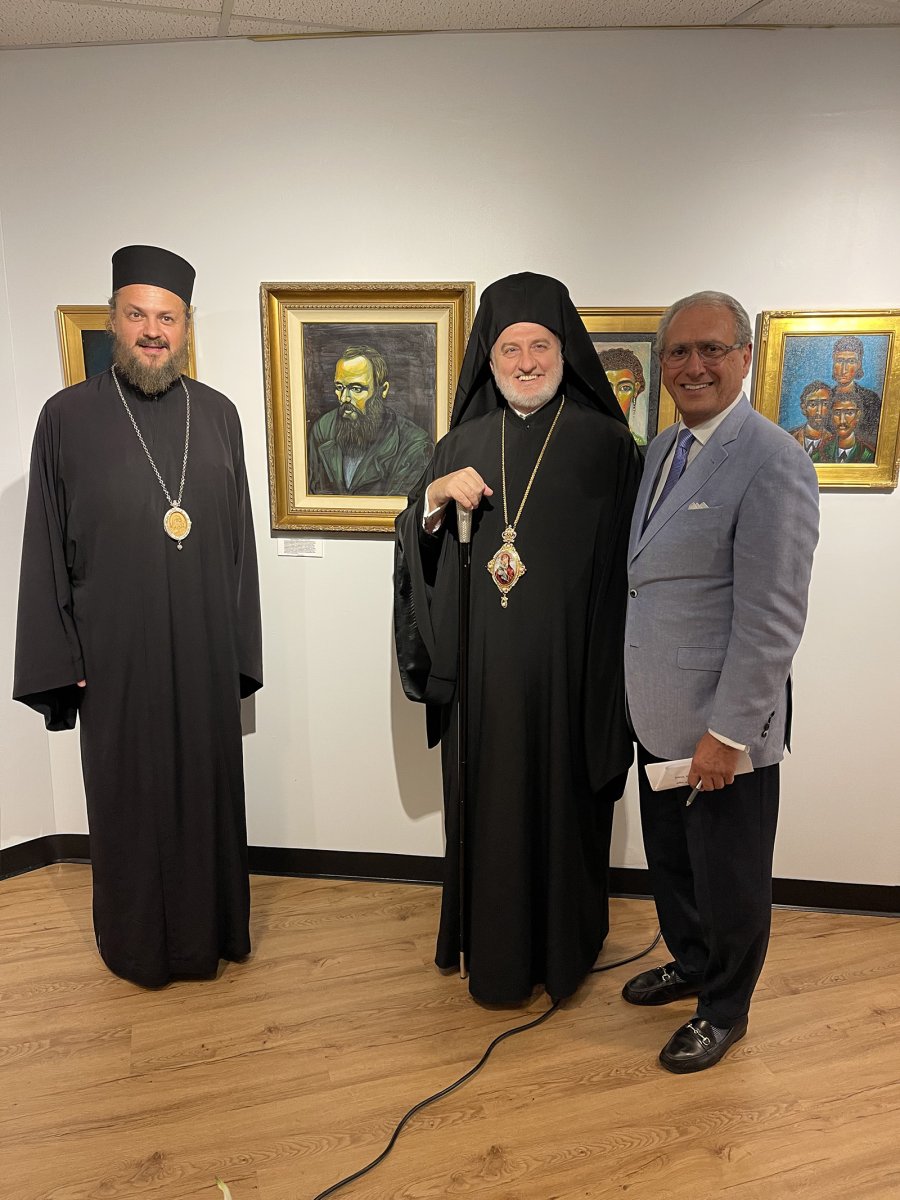
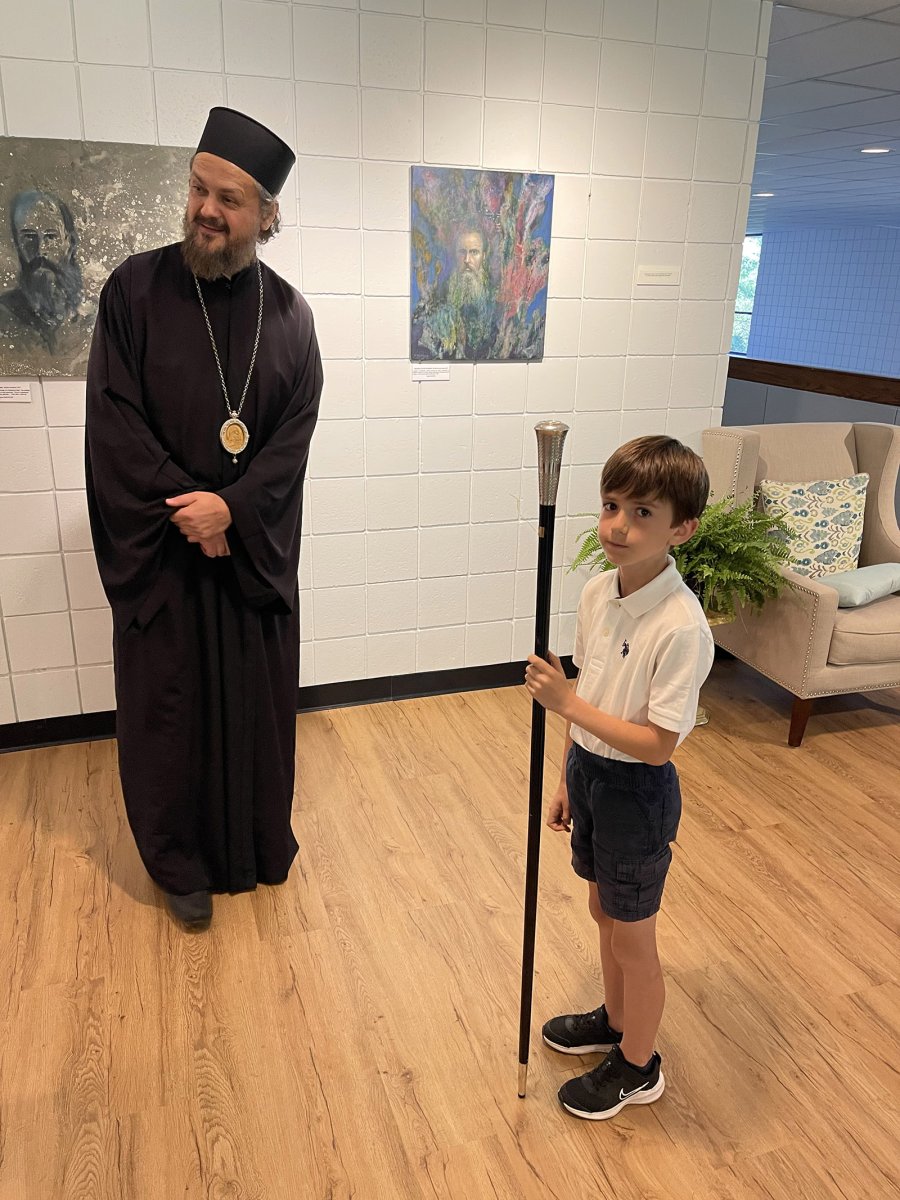
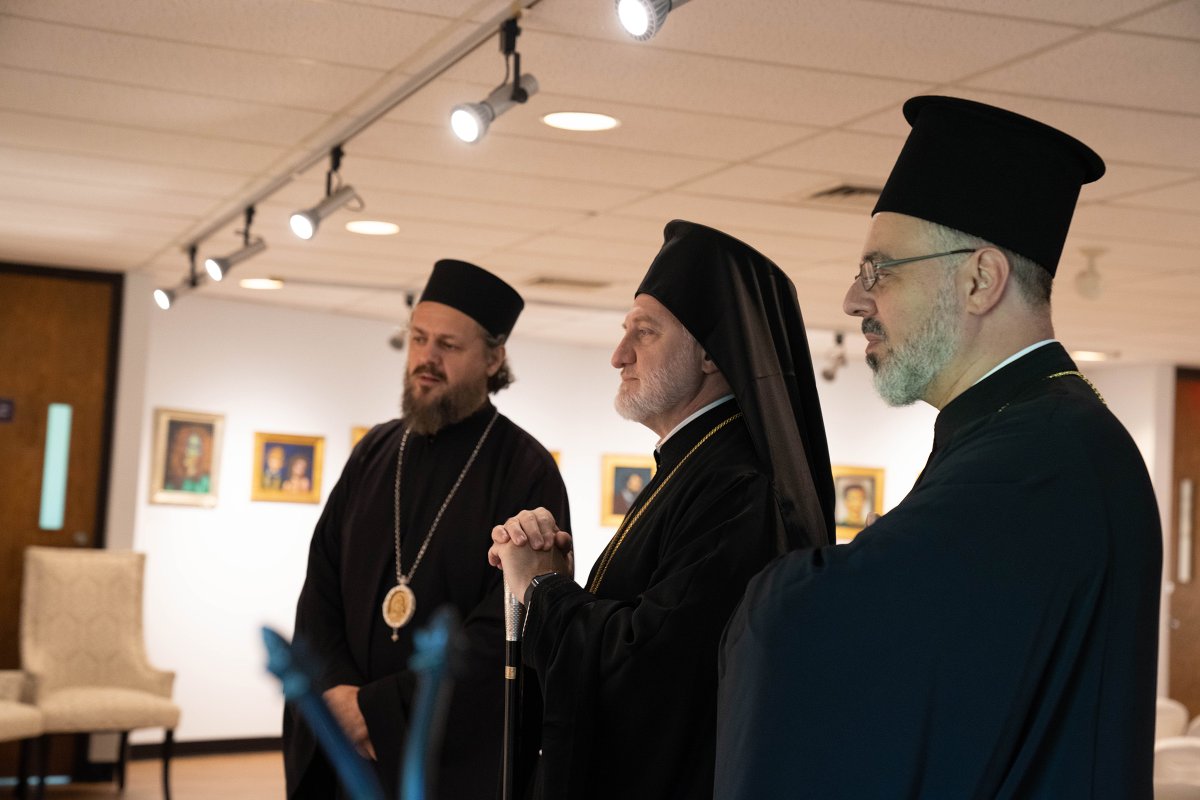
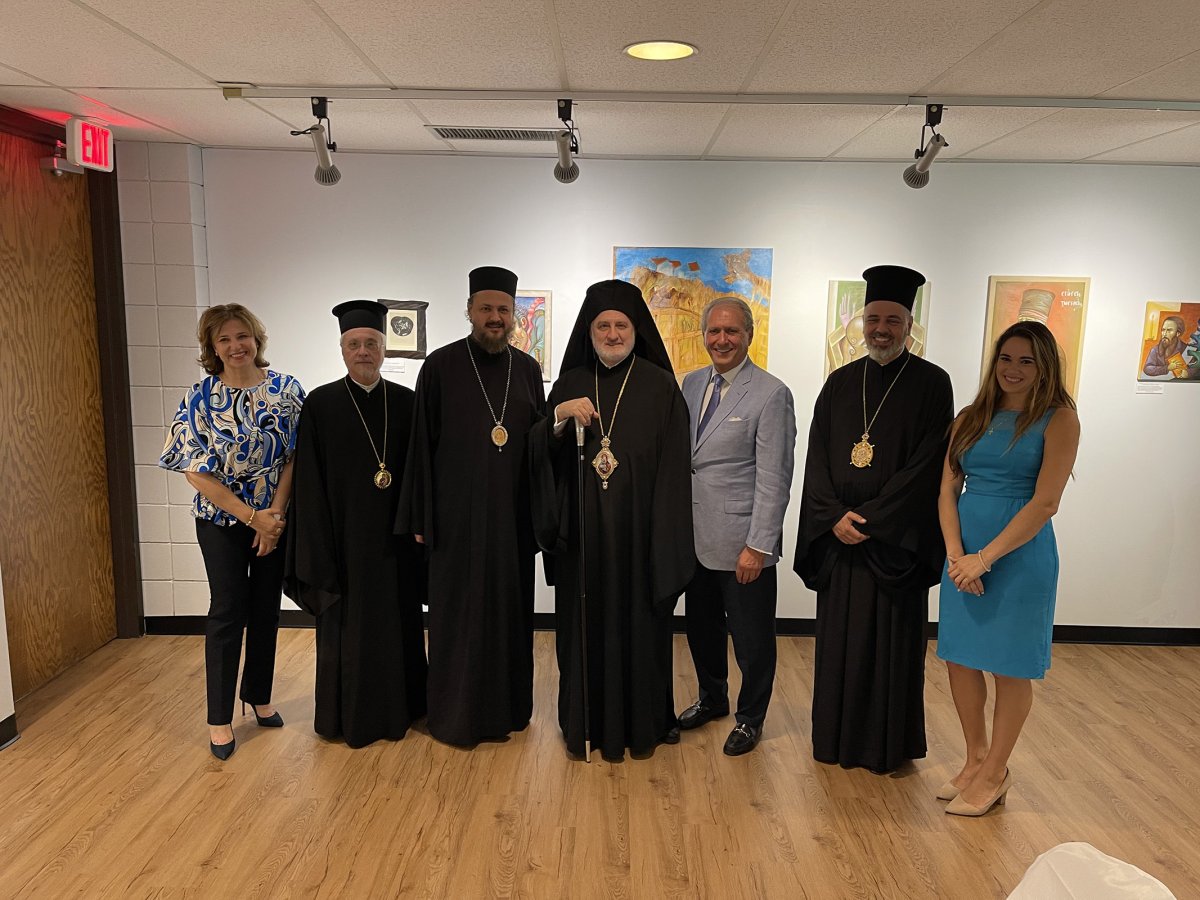
A talk delivered at a painting exhibition “Saved by Beauty” at The Maliotis Cultural Center, Hellenic College Holy Cross, Brookline, June 24, 2022
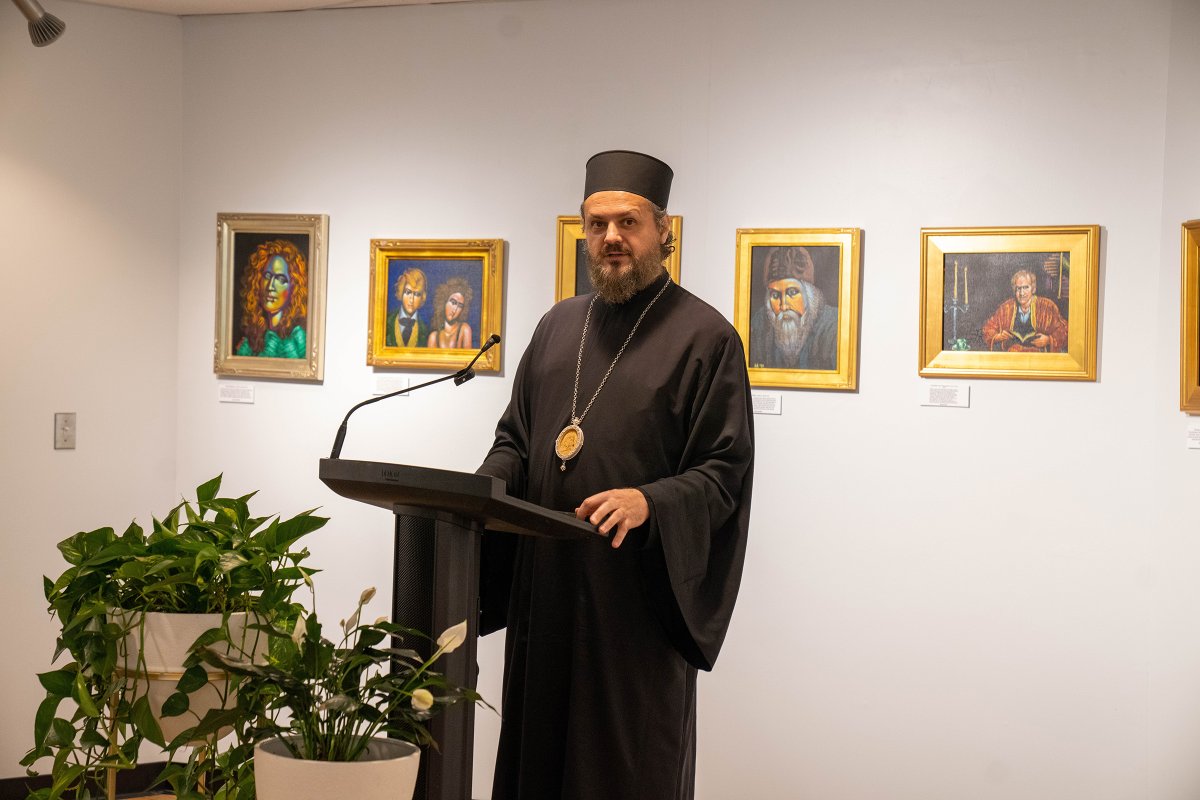
Very Reverend Fathers,
Dear guests,
Kindly allow me to congratulate The Maliotis Cultural Center Executive Director Presbytera Chrysoula Kourkounti, and Assistant Director Markella Patitsas for welcoming the idea of hosting an exhibit during this summer season dedicated to Fyodor Mikhailovich Dostoevsky, an event fitting into Boston’s cultural and intellectual environment.
My sincere gratitude goes to His Eminence Archbishop Elpidophoros of the Greek Archdiocese, who embraced the proposal of sponsoring and promoting this crucial exhibit.
The group “Ochra” was established in 2018 in Athens and its main goal is to continue the traditional Byzantine style painting in our postmodern world. According to George Kordis, “based on the belief that this style is a complete and integrated painting system the artists joined the group attempt to use this artistic language not only in rendering religious themes, but in visualizing the contemporary life, the feelings, and the anxieties of contemporary people and mostly to capture and render in visual terms their hopes and their vision for a better world. A world characterized by reconciliation, peace, love and above all by the unity of a community.”
A Community with Those Who Disagree With Us
Christian Bobin remarked: “I have never met an admirer of Dostoevsky, but I have met many who were deeply shattered after reading his works.” His heroes do not want to spend their lives in the elusive pursuit of happiness—they want the true, living life.
When he first appeared on the Russian literary horizon, Dostoevsky stunned his readers and his words opened their eyes to new perspectives. This is because the structure of Dostoevsky’s fictional world is polyphonic and, as Mikhail Bakhtin claims, “profoundly pluralistic.” A well-known remark about Dostoevsky’s philosophical polyphony stemmed from his faith in true equality of all people before God.
Dostoevsky did not advocate a narrow anthropocentric position when he defended the view that God cannot be reached through ideas, not even through religion if it ignores the reality of man as a living image of God. Driven by some other, internal suppositions, he managed to overcome the “pure” humanistic temptation.
The Magic of Narration
In Dostoevsky we find all we need to be thoroughly awakened from our lethargic state; active love as a harsh and fearful thing, personal guidance through the dark spaces of the subconscious, compassion with hearts radiating sorrow because of unrepented sins, silhouettes of sickly heroines, eccentrics in grotesque poses, mysterious footsteps in a dark passage towards sunrise on the Volga River ... Some heroes are willing to abuse everything, including the truth; others, on the other hand, seek pleasure everywhere and in everything, even in that which is purest, revealing the best and worst of human nature in the process.
The magic of his narration is metaphysical. Just as van Gogh used light to lend the painting of a pair of worn-out leather clogs an ethereal quality, so did Dostoevsky use words to lend an ethereal quality to his characters such as drunks, prostitutes, snivellers, and made them our kin, because they and we share a common hope in that which transcends time. As an author, he does not maintain a safe distance from some two-dimensional characters that feel like museum pieces, but keeps close company with those flawed, intense and broken personalities. Sometimes their physiognomy is so unstable that, in the words of Fr. Stamatis Skliris, it is reminiscent of Picasso before Picasso. What prevents these characters from ending up in nihilism, as Skliris observed, is their “apophaticism which, even in the event of failure, leaves room for something better to happen in the future, for hope that they will have a real relationship in the future.”
Dostoevsky’s artistic view was influenced not only by the moments of revelation, but also by his Siberian exile, torture, epilepsy, poverty, the desire to gamble, his passions, and the crises he went through. Having had the power to sublimate these extreme experiences, Dostoevsky spoke in the prophetic language, that is, in the sincere language of universal experience.
To elucidate his comparison between Dostoevsky and Van Gogh, we can add that:
a) madness seems to weave the brushstrokes/ink in a panicked way that gives the painted surface/novel a pulse; b) the genius seems to manipulate the panicked touch to create a successful tumor formation; c) the freedom that madness gives them leads to inexplicable unpredictability, which give the painting/novel an inconsistent, exotic, paradoxical, original character and in the final analysis build a unique artistic identity, as if only one man paints/writes them that way.
Rebellion against “Eternal Principles”
Taken aback by details and complexities of his critical and aesthetic vision, we become more capable of discerning what the illusion of virtue is and what the modesty that delights is. According to Maria Skobtsova, Dostoevsky “rises even against the laws of virtuous necessity.”
In his recent book about Dostoevsky, reposed bishop Atanasije Jevtić, also one of the great connoisseurs of the Russian writer, boldly states: “The truth which forces me to accept it, denies both me and itself.” Consequently, in our search for the living God, we are certainly not deprived of rights and should rebel against “eternal principles” and “objective truths.” Dostoevsky’s heroes, therefore, are not epigones who submissively mimic the gurus, but are free people who freely express their thoughts and defend their views—similar to Orthodox monasticism, where monks are free to voice their thoughts. This stands in stark contrast to the inquisitor who falls into the trap of underestimating man and assumes the prerogatives of God by attempting to manipulate man’s conscience.
This brings us to Dostoevsky’s next important topic.
The Weakness that Conquers
Enduring the hardships of existence in sin brought on by loveless loneliness is hard enough. In Dostoevsky’s novels we find a much-needed encouragement to start breathing freely, with full lungs. It is that breath that resurrects downcast souls. His ideas are potent and can inspire us to perhaps begin to live a living life again, responsibly and selflessly. Dostoevsky indeed strives to make us aware that freedom is the most precious gift and that life is inconceivable without suffering.
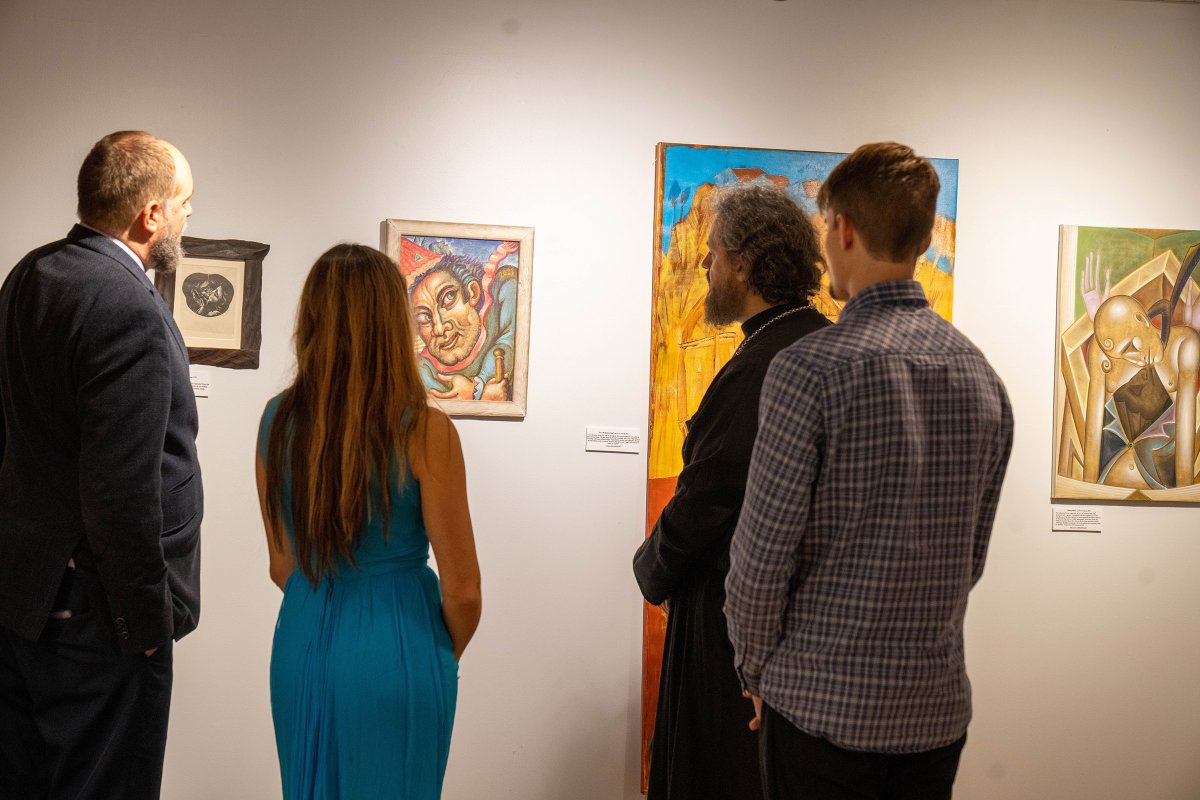
If you look at “The Underground Man” (acrylic on canvas, 2021, Stamatis Skliris) you will notice that the underground space is not a real-life one, but rather a conventional rendition of the hero’s descent into solitude and alienation. His wide-open eyes desperately try to restore substantial communication channels, and his face, deeply etched by the agony of his spirit, mirrors the labyrinth he finds himself in.
Vasileios of Iveron: “Dostoyevsky comprehended an important idea that we find in St. Isaac the Syrian. St. Isaac says that God does not give His great gifts without a serious examination. Therefore, the one who is not inclined to pass through great temptations cannot receive God’s great gifts. I believe that Dostoyevsky gives us exactly this message: a person without great temptations cannot arrive at great values. Reading Dostoyevsky, you are not simply reading crime novels but receiving a testimony that you reach life through death.”
The gaze of the long-suffering, but blessed Dostoevsky crystallizes in that portrait. When we look at him and his eyes and then his torn coat, we can say: this man has gone through a storm, yet his eyes possess a sweetness that says: Thank God, we are saved!
I invite you to look at “Sonia Marmeladova”, acrylic on canvas, 2021, painted by Fr. Stamatis Skliris. She looks like a simple young woman who is led astray into corrupt paths by her beauty and love for her failed father. Yet, her eyes show the ethe:real oil of her devotion to her father and her loved one, and this devotion is precisely what saves an uncorrupted integrity deep in herself.
Instead of Conclusion
The words of Marmeladov—which after all describe Christ who welcomes all at the end of time, all those damaged, failed, and humiliated people—are undoubtedly an echo of the Easter Sermon (attributed to St. John Chrysostom) which is read during Matins of Pascha, the service that begins Easter. This Sermon reveals the Paschal logic with the following words: all is filled with light, all are called to the feast of faith, no-one is to remain hungry, and those who have fasted and those who have not, let all enter the feast of joy, that no-one should remain dead in the grave, but than all should rise from the graves.
May I, once again, express my profound gratitude to Maliotis Cultural Center, which has fostered this exhibition.
Thank you very much!