A great man is one who collects knowledge the way a bee collects honey and uses it to help people overcome the difficulties they endure - hunger, ignorance and disease!
- Nikola Tesla

Remember, remember always, that all of us, and you and I especially, are descended from immigrants and revolutionists.
- Franklin Roosevelt

While their territory has been devastated and their homes despoiled, the spirit of the Serbian people has not been broken.
- Woodrow Wilson

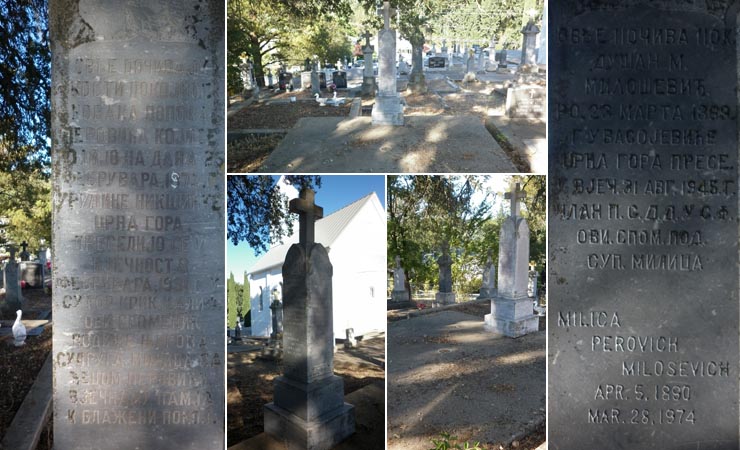
Perovich Novak 1873 - 1931, Milica 1880 - 1974; Milosevich Dušan M. 1889 - 1945

(Предња страна споменика)

 ОВЂЕ ПОЧИВАЈУ

КОСТИ ПОКОЈНОГ

НОВАКА ПОПОВА

ПЕРОВИЋА  КОЈИ СЕ

РОДИЈО НА ДАНА 25

ФЕБРУВАРА 1873. Г. 

УРУДИНЕ НИКШИЋКЕ

      ЦРНА ГОРА

ПРЕСЕЛИЈО СЕ У 

   ВЈЕЧНОСТ. 8

ФЕБРУВАРА, 1931. Г. У

СУТОР КРИК, КАЛИФ

  ОВИ СПОМЕНИК

ПОДИЖЕ ЊЕГОВА

СУПРУГА МИЛИЦА СА

ЂЕЦОМ ПЕРОВИЋИ

ВЈЕЧНАМУ ПАМЈА

И БЛАЖЕНИ ПОКОЈ.


(Бочна, лева страна споменика)


ОВЂЕ ПОЧИВА ПОК.

         ДУШАН М.

     МИЛОШЕВИЋ

РО. 23 МАРТА 1889.

Г У ВАСОЈЕВИЋЕ

ЦРНА ГОРА ПРЕСЕ.

У ВЈЕЧ. 31 АВГ. 1945 Г.

ЧЛАН П.С.Д. Д. У С. Ф.

  ОВИ СПОМ. ПОД.

   СУП. МИЛИЦА

MILICA

 PEROVICH

  MILOSEVICH

APR. 5, 1880

MAR. 28, 1974


SA


People Directory

Momčilo Moma Nikolić

Momo was born in the ancient city of Novi Sad in Vojvodina, a multi-cultural province of the former Yugoslavia. The rich heritage of his upbringing instilled in him a love of Slavic and classical music. Momo studied music at the music school "Isidor Bajic" in Novi Sad. He is an extremely gifted musician, who plays many stringed instruments. Momo plays the Prim Tamburitza, and is known to be a master of this instrument. He was a member of the great Tamburitza orchestra of RTV-Novi Sad (1970-1990) as instrumental soloist. He is best known in performing with the legendary Janika Balaz Orchestra "8 Tamburitza of Petrovaradin."

.
Read more ...

Publishing

God Views Us Through Love

by Ignatije (Midic), bishop of Branicevo-Pozarevac

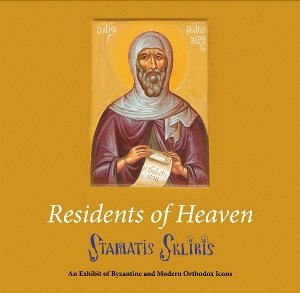
The present volume collects essays and articles written by Bishop Ignatije on man within history and within the Church; on the roots of the Church according to Saint Maximus the Confessor; on how God views us through love; about a call to rediscover our true self in our neighbor; on reconciliation in society and policy; on iconising that which is to come seen in the Iconography of Stamatis Skliris.